The 5 Most Popular Bar Drinks in the World (and Their Mocktail Twins)
Ever stood at a bar while everyone orders a Negroni or a spicy marg and wondered what on earth you’d order if you weren’t drinking? Hi. That was me, basically every Friday after I quit.
Heads up: this post has a few Amazon links. As an Amazon Associate I earn from qualifying purchases, at no extra cost to you. It keeps the ice cubes coming.
So I did what any slightly obsessive mocktail person does. I went looking for the drinks people actually order the most, and then I built a sober twin for every single one.
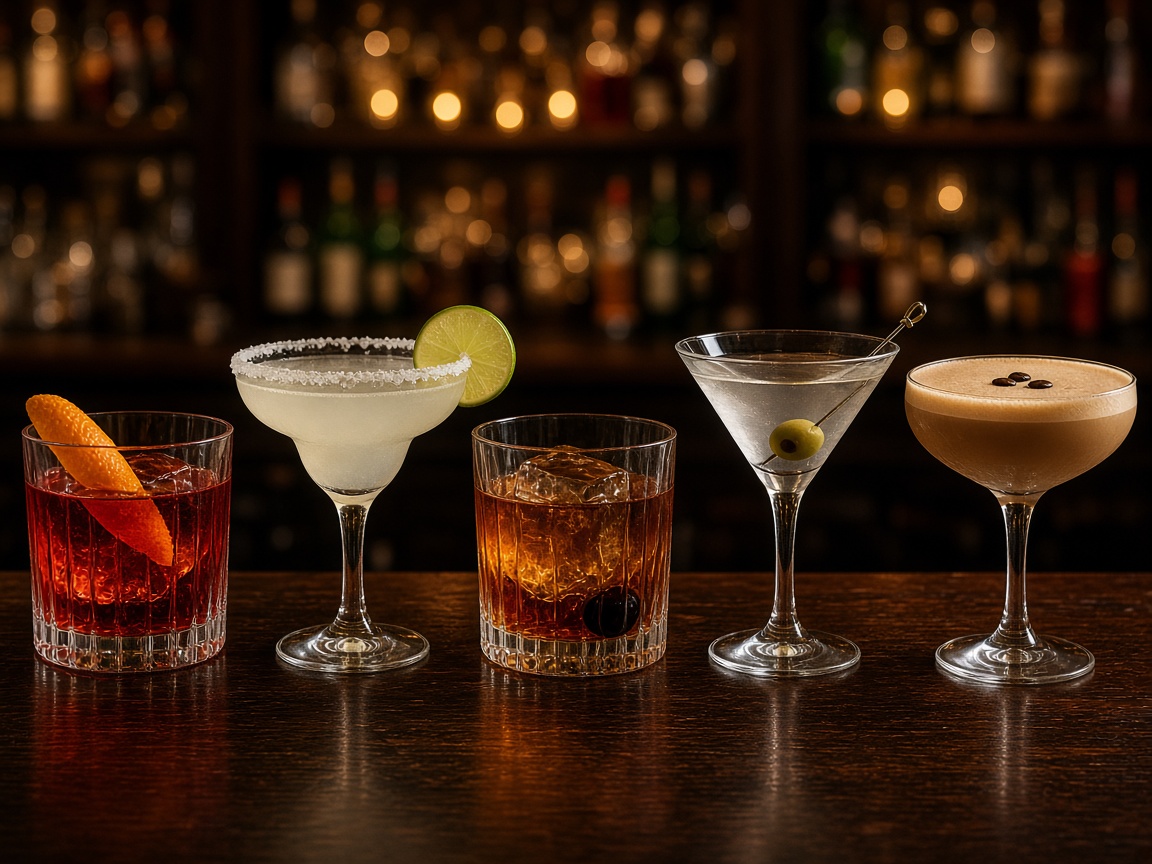
Every year, Drinks International asks around 100 of the world’s best bars to name their 10 bestselling classic cocktails. The 2026 list came out on April 28, and the top five are the Negroni, the Margarita, the Old Fashioned, the Dry Martini and the Espresso Martini.
Below you’ll find the story behind each one (some of these origin stories are, let’s say, a little spicy and very disputed), a mocktail twin that looks and tastes the part, and exactly what to say to the bartender. The featured No-groni recipe is at the bottom, because a bitter red drink with an orange peel is my love language.
Quick heads-up before we start
This ranking is what the world’s top cocktail bars sell the most. It’s not a survey of every bar on Earth. Your neighborhood dive bar might be pouring a totally different top five, and that’s fine. I’m not here to judge your local’s beer-and-a-shot special.
Also: when I mention which drinks are popular in which US states, that’s based on search interest (what people Google), not sales. Different studies use different methods, so treat it as fun trivia, not gospel.
Each twin below gets a short description and a quick way to make it. Only the Coffee Mocktini has its own full recipe on the site right now. The others are coming soon, and I’ll link them here as each one goes live.
1. The Negroni (and its twin, the No-groni)
The story
The usual story goes like this: around 1919, Count Camillo Negroni asked bartender Fosco Scarselli at Caffè Casoni in Florence to swap the soda in his Americano for gin. Boom. Stronger drink, happier Count.
The drink’s name shows up in a surviving letter from October 1920, and then it pretty much vanishes from print until 1947. Heads-up: the 1919 date and even the Count’s title are disputed. There’s also a competing claim from the Corsican Negroni family, but historians don’t buy it, because Campari didn’t even exist yet at that point. Oops.
The mocktail twin: No-groni (featured recipe)
Equal parts non-alcoholic bitter red aperitif, non-alcoholic red vermouth-style aperitif and non-alcoholic gin (or dry white verjus if you don’t have NA gin), stirred over ice and finished with a big orange peel. It’s bitter, a little sweet, deep ruby red and SO grown-up. Nobody at the table will know it’s not the real thing unless you tell them. Get the No-groni recipe below.
How to order it at a bar
Say: “Do you have a non-alcoholic aperitif or NA vermouth? Could you make me a Negroni-style drink with those, stirred, with an orange peel?” Lots of cocktail bars have at least one NA bottle tucked away these days, but not all.
Plan B if they don’t: tonic water over ice with a big orange peel. It’s got that bitter edge and it looks great in a rocks glass.
Where it’s popular
Honest moment: I couldn’t find solid US regional data for the Negroni, so I’m not going to make anything up. Just know it’s number one at the world’s best bars, which is a pretty good flex.
2. The Margarita (and its twin, the Mocktail Margarita)
The story
Ooh, this one is disputed with a capital D. One claim credits Carlos “Danny” Herrera at Rancho La Gloria near Tijuana. Fun fact: he gave three different years for it (1938, 1947 and 1948) at different times. Another claim credits Dallas socialite Margarita Sames, at a party in Acapulco in 1948.
But here’s the plot twist. A 1945 Jose Cuervo ad already used the line “Margarita: it’s more than a girl’s name.” So somebody was ahead of somebody. The first written recipe showed up in Esquire in 1953.
The mocktail twin: Mocktail Margarita
Bright lime, fresh orange and a touch of orange zest for that orange-liqueur vibe, sweetened with agave and served with a salt rim. The full recipe is coming soon. Want one tonight? Here’s my quick riff:
- Run a lime wedge around the rim of a glass and dip it in flaky or kosher salt.
- Shake 1 oz fresh lime juice, 1 oz fresh orange juice, 1/2 to 3/4 oz agave syrup and a pinch of finely grated orange zest with ice.
- Strain over fresh ice and add a splash of sparkling water if you like it lighter.
- Spicy marg person? Muddle a thin slice of jalapeño in the shaker first.
How to order it at a bar
Say: “Could I get a margarita with no tequila? Fresh lime, orange juice and agave, shaken, salt rim.” Pretty much every bar with a citrus station can do this. Add “spicy, please” if they have jalapeños. And say “no alcohol” out loud, because a margarita without tequila sounds like a typo to a busy bartender.
Where it’s popular
According to The Kitchn’s Google Trends analysis of 25 cocktails (2025), the Margarita was the most-searched cocktail in 29 states, across the South, Midwest and West. That’s search interest, not sales, but still. The marg is a people’s champion.
3. The Old Fashioned (and its twin, the Smoked Cherry Old Fashioned)
The story
The Old Fashioned is basically the original cocktail. In 1806, a newspaper in Hudson, New York, called The Balance and Columbian Repository, defined a “cock-tail” on May 13 as spirits, sugar, water and bitters. That’s… an Old Fashioned.
Later, when fancy vermouth drinks took over, people started asking for their cocktails the “old-fashioned” way. The name first shows up in print in the Chicago Tribune in 1880.
You might have heard that the Pendennis Club in Louisville invented it. That one’s debunked: the club was founded in 1881, a year after the name was already in print, so at most it helped make the drink popular. Oh, and in Wisconsin, it’s made with brandy. Respect.
The mocktail twin: Smoked Cherry Old Fashioned Mocktail
Strong black tea (or a non-alcoholic whiskey alternative) stirred with maple syrup, alcohol-free bitters, orange and a dark cherry. The full recipe is coming soon. Quick riff for tonight:
- Brew lapsang souchong (a smoky black tea) or any strong black tea, double strength, and let it cool.
- Stir 2 oz of the cooled tea (or NA whiskey alternative) with 1 to 2 tsp maple syrup and 2 to 3 dashes of alcohol-free bitters over ice.
- Strain over one big ice cube, squeeze an orange peel over the top and drop in a dark cherry.
Bitters warning: regular cocktail bitters are made with alcohol. They’re used in tiny dashes, but if you’re avoiding alcohol completely, buy bottles labeled alcohol-free (usually glycerin-based) or just skip them.
How to order it at a bar
Say: “Do you have a non-alcoholic whiskey? Could you make it like an Old Fashioned, with no regular bitters, an orange peel and a cherry?” Mention the bitters, because bartenders add them on autopilot.
Plan B: ask for a muddled orange and cherry with a little simple syrup, topped with ginger ale over a big cube. Not the same, but it scratches the amber-drink-in-a-heavy-glass itch.
Where it’s popular
In The Kitchn’s 2025 analysis, the Old Fashioned topped 5 states (Alaska, Idaho, Minnesota, West Virginia and Wisconsin), mostly the Upper Midwest and Mountain areas. Delish’s 2024 Google Trends data had it on top in 7 states, including Montana and South Dakota. And The Ice Maker Hub’s study of recipe searches ranks it number one in 34 states. Different methods, very different answers, which is why I keep saying search interest, not sales.
4. The Dry Martini (and its twin, the NA Dry Martini)
The story
Nobody agrees on this one, so file the whole thing under disputed. The two main stories:
- It slowly evolved from the sweeter Martinez of the 1860s to 1880s, a drink linked to either Martinez, California, or famous bartender Jerry Thomas.
- A bartender named Martini di Arma di Taggia created it at New York’s Knickerbocker Hotel before World War I.
And there’s a third theory that the name comes from the Martini & Rossi brand. Pick your favorite and defend it at parties.
The mocktail twin: NA Dry Martini
Ice-cold non-alcoholic gin stirred with a little dry white verjus (tart, unfermented grape juice) for that crisp vermouth vibe, finished with a lemon twist or an olive. The full recipe is coming soon. Quick riff:
- Chill a martini glass in the freezer for 10 minutes.
- Stir 2 oz NA gin alternative and 1/2 oz dry white verjus with plenty of ice for about 20 seconds.
- Strain into the cold glass and add a lemon twist or a green olive.
- Want it dirty? Add 1 to 2 tsp olive brine.
How to order it at a bar
Say: “Do you have a non-alcoholic gin? Could you stir it really cold and serve it up in a martini glass with olives?” Or a twist, if you’re a lemon person.
Plan B if there’s no NA gin: soda water with a splash of olive brine and a couple of olives, in a martini glass. Is it weird? A little. Is it fun to hold? Extremely.
Where it’s popular
The Kitchn’s 2025 analysis had the Martini on top in 14 states, mostly in the Northeast and Mid-Atlantic (Connecticut, Delaware, Maryland, Massachusetts, New Hampshire, New Jersey, New York, Pennsylvania, Rhode Island and Virginia), plus Florida, Michigan, Nevada and Washington. Delish’s 2024 Google Trends data shows the same Northeast cluster.
5. The Espresso Martini (and its twin, the Coffee Mocktini)
The story
This one has an actual inventor, which is refreshing. Bartender Dick Bradsell created it in Soho, London, in the mid-1980s. It started life as the “Vodka Espresso,” served on the rocks, and he renamed it the “Espresso Martini” at Match EC1 in 1997.
The disputed part: which venue it was born in (Soho Brasserie or Fred’s Club) and which year (1983 or around 1985).
The mocktail twin: Coffee Mocktini
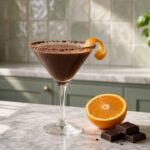
This twin is already live, and it’s one of my favorites on the whole site. Espresso, a little sweetness and a hard shake for that thick, foamy top, finished with three coffee beans like the fancy-pants version. Get the Coffee Mocktini recipe.
How to order it at a bar
Say: “Could you make an espresso martini with no vodka? Just espresso and simple syrup, shaken hard, served up.” Most cocktail bars that make espresso martinis have the espresso ready to go, so this is one of the easiest sober orders out there. Heads-up: it has caffeine, so maybe not your 11 PM order.
Where it’s popular
Power Brands’ 2025 Google Trends study of 100 cocktails (reported by the Asbury Park Press) found it leads in the Northeast. The Ice Maker Hub’s keyword study (August 2024 to July 2025) ranks it number one in Massachusetts, Connecticut and Rhode Island. New England loves its coffee. Shocking, I know.
Your bar-order cheat sheet
- Negroni person: “NA aperitif and NA vermouth, Negroni-style, stirred, orange peel.” Plan B: tonic with an orange peel.
- Margarita person: “Margarita with no tequila. Lime, orange juice, agave, salt rim.”
- Old Fashioned person: “NA whiskey, Old Fashioned-style, no regular bitters, orange and cherry.”
- Martini person: “NA gin, stirred cold, up, with olives or a twist.”
- Espresso Martini person: “Espresso martini with no vodka, shaken hard.”
- Always: say “no alcohol, please” clearly, and ask how the NA bottle is labeled if you need truly zero alcohol.
Want the full playbook for ordering sober anywhere? Check out my guide to what to order at a bar when you’re not drinking. And if your crew is more of a beer crowd, here’s what to order at a brewery.
Allergy, caffeine and label notes
- Trace alcohol: some products labeled “non-alcoholic” can still contain a tiny amount of alcohol. If you need zero (recovery, pregnancy, medication), read the label for the ABV or ask to see the bottle.
- Bitters: regular cocktail bitters contain alcohol. Use alcohol-free bitters or skip them.
- Sulfites: verjus and some NA vermouths and aperitifs can contain sulfites. Check labels if you’re sensitive.
- Botanicals and colorings: NA spirits are made with lots of herbs, roots, spices and sometimes added colors. If you have a food allergy, check the full ingredient list.
- Caffeine: the Coffee Mocktini (espresso) and the black tea in the Old Fashioned twin both have caffeine. Use decaf espresso or a caffeine-free rooibos tea for a late-night version.
- Quinine: tonic water contains quinine, so skip the tonic plan B if your doctor has told you to avoid it.
- Salt and brine: the margarita rim and dirty martini brine add sodium. Go light or skip them if you’re watching salt.
- Citrus: lime, orange and lemon show up a lot here, so swap or skip if citrus bothers you.
Sources
- Ranking: Drinks International, The bestselling classic cocktails at the world’s best bars 2026
- Negroni: Oxford Companion to Spirits and Cocktails; WSET; Campari
- Margarita: Smithsonian; National Geographic
- Old Fashioned: Oxford Companion; Chanticleer Society cocktail timeline; Virginia Tech library guide
- Espresso Martini: Oxford Companion; CLASS (Bea Bradsell); 12×75
- US search interest: The Kitchn; Delish; Asbury Park Press (Power Brands study); The Ice Maker Hub study
Tools to use: a jigger so the ratios behave, on Amazon. Any brand works.
No-groni (Non-Alcoholic Negroni)
Ingredients
- 1 oz non-alcoholic bitter red aperitif Campari-style; check the label for ABV
- 1 oz non-alcoholic red vermouth-style aperitif sweet (rosso) style
- 1 oz non-alcoholic gin alternative or dry white verjus for a tangier, gin-free version
- 1 large ice cube plus more ice for stirring
- 1 strip strip orange peel about 2 to 3 inches, cut with a vegetable peeler
- 1 tsp simple syrup optional, if you like it less bitter
Instructions
- Pop a rocks glass in the freezer for a few minutes while you gather everything.
- Fill a mixing glass (or any big glass) about two-thirds full with ice. Add the NA bitter aperitif, NA vermouth-style aperitif and NA gin (or verjus).
- Stir with a long spoon for 20 to 30 seconds, until the outside of the glass feels really cold.
- Put the large ice cube in your chilled rocks glass and strain the drink over it.
- Hold the orange peel skin side down over the glass and give it a firm twist to spray the oils over the drink. Rub it around the rim, then drop it in.
- Taste. Too bitter? Stir in the simple syrup, or top with a splash of soda water for a lighter, spritzy version.